

Who was St. Patrick?
The Story of St. Patrick

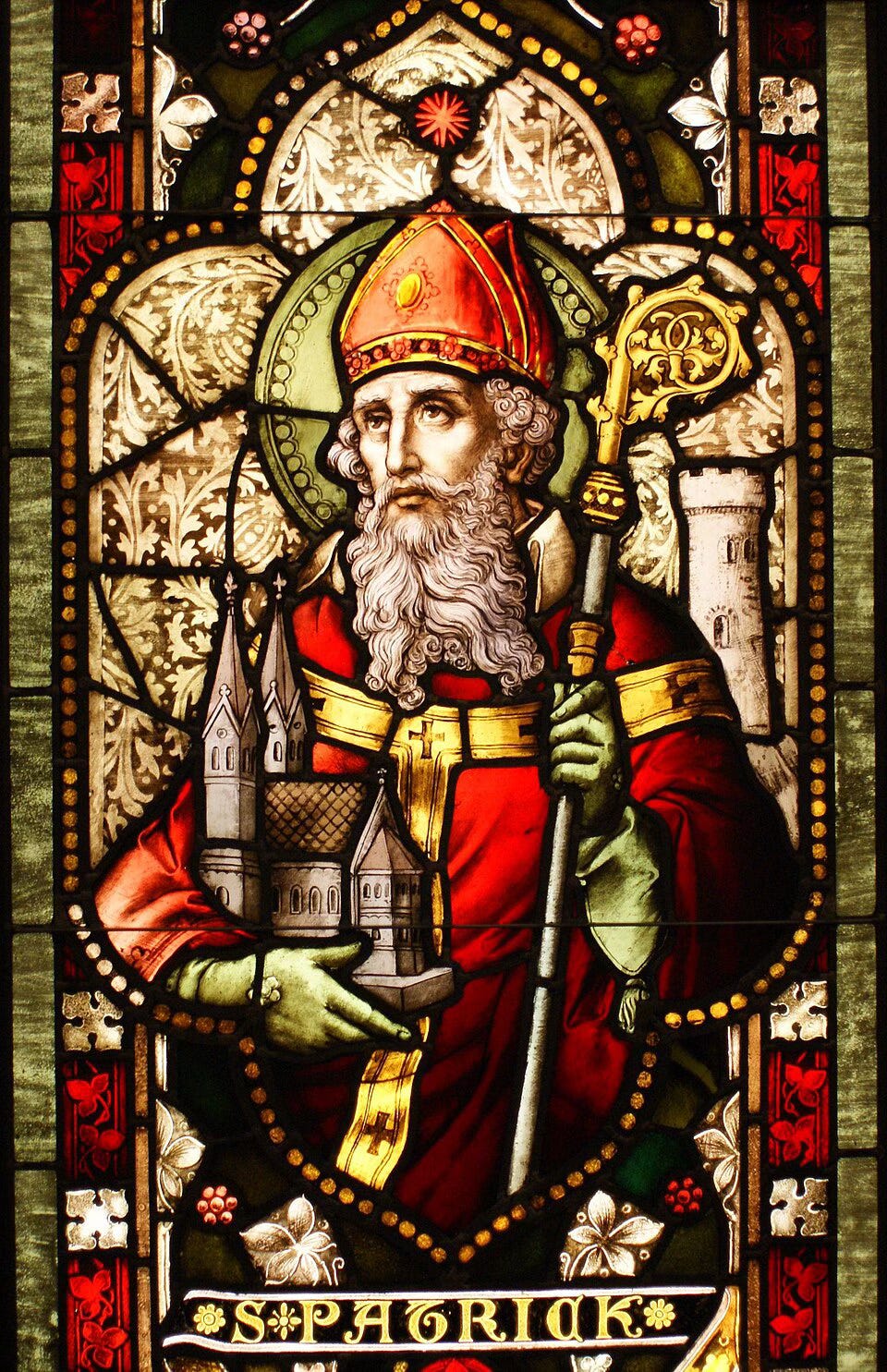
Every year on March 17, rivers turn green, millions of people drink Guinness in costumes, and even big cities celebrate St. Patrick’s Day. Chicago pumps green paint into its river and New York hosts the largest parade in the world. Sydney, Tokyo, Buenos Aires – the Irish flag flies everywhere. But who was the real St. Patrick?
Around the year 385 AD, a boy is born in a villa somewhere in Roman Britain. His name was Patricius. Where exactly he grew up is still controversial today. Some historians locate his homeland in present-day Wales or in the north of England. The Roman Empire in which he grew up was no longer one of great expansion. It is a kingdom in retreat. The borders are crumbling, the provinces are becoming more uncertain, and Rome’s authority in faraway Britain hardly reaches the sea. And on the other side of the sea, on the island in the west, lives a people that Rome has never defeated: the Irish. Patrick is sixteen years old when his life splinters in a single moment. Irish pirates invade his family’s estate, whereupon he is kidnapped and ends up as a slave in Ireland along with thousands of other Britons. It is shipped to the west or north of the island – the exact region is unknown, Patrick himself mentions a place called Foclut. There he spent six years as a shepherd and deepened his faith.

In the Confession, he describes how he prayed hundred times a day, and another hundred times a night. Faith, to which he had paid little attention in his childhood, becomes the only constant of his life in servitude. Six years later, he experiences what he describes as divine inspiration: In a dream, he hears a voice telling him that his ship is ready. He should set off. He escapes, on foot, over hundreds of kilometers, to a coast where a ship is actually moored, whose captain finally takes him along. He finally comes home, but his sleep is bad. He dreams of voices – this time, it is the Irish who call him. However, Patrick must first be trained in theology before he can return to Ireland.
The exact stages of his theological training are historically unclear. He may have studied in Gaul, present-day France, perhaps in the monastic community of Lérins or with Bishop Germanus of Auxerre. He was ordained a priest and later ordained a bishop. Sometime in the 430s, he returns. As a free man, he enters an island where he was once a slave. Ireland in the 5th century is a world of tribal chiefs, druids and Celtic gods. There are no cities, no Roman structures, no bishops, no churches. The Christian faith that Patrick brings with him must hold its own in a society that is not prepared for it. He baptizes, preaches, founds communities. He travels all over the country, from chief to chief, from tribe to tribe. He pays for protection, is sometimes captured, sometimes threatened. He describes in the Confessio how his life was in danger twelve times. What is particularly remarkable is how he deals with Irish society: he does not try to destroy it, but to transform it. He learns the language. He respects the structures. He wins local chiefs as allies and sometimes as converts. He ordains locals as priests and bishops – a truly progressive step for the time. Among his baptismal candidates were demonstrably women from the Irish nobility, whom he encouraged to virginity and monastic life. Surprisingly, two documents from St. Patrick that are recognized as authentic have survived.
The Confession: It is the longer of the two works. It is comparable to an autobiography, a spiritual testament. His public justification of his life and work, written at the end of his active years. Patrick explains why he went back to Ireland, defends himself against critics in the British Church who have doubted his character and suitability, and thanks God for everything that has happened to him – including slavery.
The letter to Coroticus: Coroticus was a British military leader – possibly a Welshman whose soldiers ambushed, killed and enslaved a group of Irish Christians whom Patrick had just baptized. Patrick writes an open letter to Coroticus and to the society that tolerates him. He calls him a murderer, a traitor to the faith. He demands the release of the prisoners. It is one of the earliest surviving documents that explicitly takes a stand against slavery.
There are also some myths surrounding St. Patrick. Patrick is said to have used the three-leaf clover to explain the Christian Trinity to Irish tribal leaders. However, it has not been handed down in the Confession or in the letter to Coroticus and is probably a more or less good legend. (It’s pretty bad to explain the trinity.) March 17 is traditionally considered the anniversary of his death. It is not historically verifiable. The exact year of his death is also unknown – estimates range from 461 to 493 AD. Nowadays, as always, St. Patrick’s Day is celebrated on March 17th. Patrick leaves behind no powerful institution, but what remains is a community. Irish monks of the early Middle Ages move from the island that Patrick had missionized to the European continent and carry Christianity to parts of Europe that are sinking into cultural chaos after the collapse of the Western Roman Empire. Irish monasteries became guardians of Latin knowledge, centres of written culture, bridges between antiquity and the Middle Ages.
The real Patrick was not a national saint in the modern sense. He was not Irish. He was British, Roman, prisoner, refugee and voluntary returnee all in one.
For further reading see:
https://www.saintpatrickcentre.com/about-st-patrick/
https://www.saintpatrickcentre.com/st-patricks-confession/
Appreciate your emphasis on primary sources! Maybe your readers would also enjoy looking at some early manuscripts with these texts, such as: https://www.confessio.ie/manuscripts/dublincodex#40 and https://vernacularbibleexplorer.substack.com/p/st-patricks-trinitarian-confessions.
This was a great read 👏🏾I was born & raised in Ireland and didn’t know this much 😅